

Multiple Consultation Prompts
For setting up the option of multiple consultation prompts, follow these steps to ensure clarity and effectiveness:
1. Navigate to your settings, then proceed to the 'prompts' section.
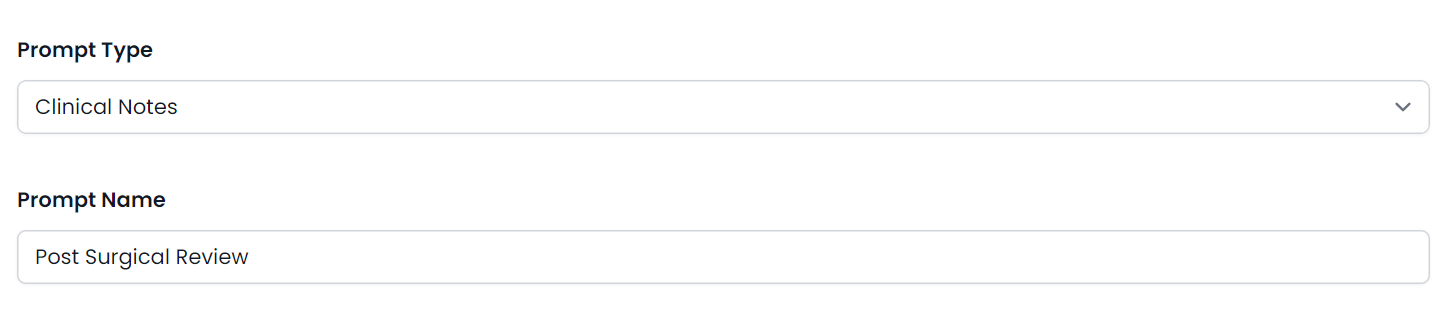
2. Click on 'Add' to create a new prompt. Ensure the Prompt Type is Clinical Notes in the drop down.
3. Enter prompt name Here, you will be required to name your prompt. Please ensure the name is clear and reflects the content or purpose of the prompt (Example= post surgical review).
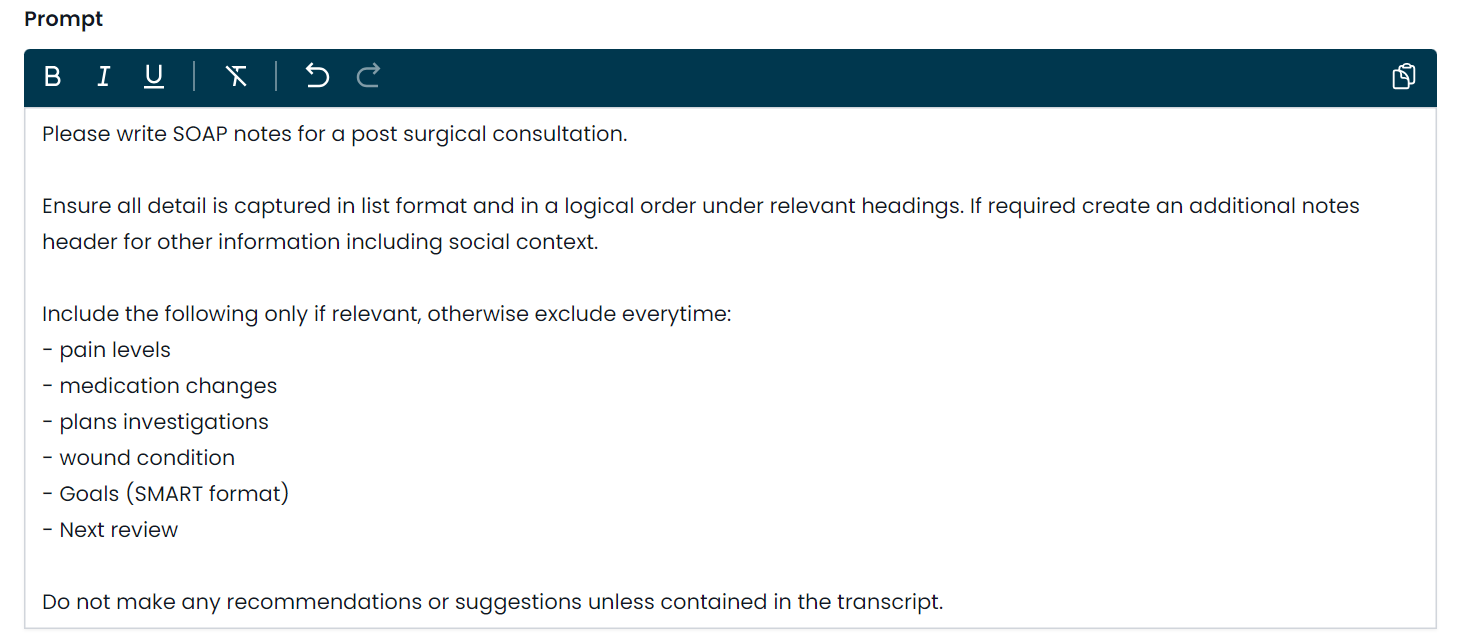
3. Once named, enter the specific context for the prompt. This context is crucial for tailoring the prompt to your specific needs. If you need assistance in developing your prompts, refer to our prompt guide for comprehensive guidance.
You can now test this against a previous consultation to ensure it is capturing your preferred language and style.
TIPS:
- When creating medical prompts, it is essential to specify the type of medical examination or consultation you are addressing. This specificity helps in generating more accurate and relevant responses.
- Keep your prompts concise, ideally under 500 words, to maintain focus and maximize the relevance of the responses.
- In developing your prompts, clearly define the persona you are adopting (e.g., medical practitioner, patient) and the prompt's objective. This clarity will guide the responses to align with your intended perspective and goals.
- Be explicit about your preferences for the content and context within the responses. While it's important to provide detailed information, avoid overloading the prompt with unnecessary details that could detract from the main focus. Allow the AI to utilize its knowledge base effectively.
- When using medical acronyms, ensure they are clearly defined at least once in the prompt to avoid ambiguity. Additional context may be added if necessary to enhance understanding.
For further inspiration or guidance, visit our recommended prompt section. This resource can offer valuable insights into crafting effective prompts.
New to PatientNotes?
Learn more about how it works or start your free trial.
Frequently asked questions
How does PatientNotes work?
Individual signs up, patient consents, session is recorded, transcribed, AI Model used to generate a draft of your clinical notes, then context gained to create a Patient Summary and any needed letters to medical professionals.
I've been told I can't use ChatGPT with patient information, is it ok to use this?
ChatGPT isn't safe to use with patient information. Data entered into ChatGPT is retained for wider language learning models and often patient information is being entered into ChatGPT without consent. PatientNotes is different. Explicit consent from the patient is required for each session. Transcripts are heavily protected with layers of encryption and strict policies, stored in Sydney in Google's HIPAA compliant data center, and automatically deleted after 30 days.
Is a special microphone required?
Most practitioners start using their default laptop microphone, however for the best results we recommend having a dedicated USB microphone on your desk. Omnidirectional USB microphones work great. Read all about our microphone recommendations on our microphone support page.
Can I use PatientNotes on my mobile phone?
Yes. Navigate to patientnotes.app on your web browser, login, and away you go. Recording works great on mobile devices and on most devices will continue even when the screen locks.
Where are PatientNotes servers located?
PatientNotes runs on servers located in Sydney, Australia. We have plans to have dedicated servers in each country with data stored locally for each user where possible eg. If a user sets their country to United States, their data will reside in the United States.
Does PatientNotes use encryption?
Absolutely. Security and Privacy is critical to protecting personal information. We encrypt all information in transit and at rest. Read more on our Security page.
Is the use of AI in healthcare safe and reliable?
We think of AI as an assistant to the medical practitioner rather than replacing the practitioner in any way. The role of our AI systems are to help produce a draft for the practitioner. Beyond that, it’s up to the practitioner to make the required changes to ensure that the notes are accurate before adding them to a patient record. More broadly, we believe AI has an incredible ability to analyse large amount of data and assist humans, but anything it produces must be validated by a qualified medical professional.
Can AI replace human doctors or healthcare providers?
No. Machines can’t replace doctors or healthcare professionals.
Does the system generate a diagnosis?
The system is fine tuned to not provide a diagnosis and focus just on the facts that were inputted by the healthcare provider during the consultation.
Does PatientNotes comply with all Australia privacy and data retention acts and legislation?
Yes. In Australia we comply with the Privacy Act 1988, Health Records Act 2001 (Victoria) and other national legislation with regards to the storage of personal information. Privacy and Security is critical to our business and we take both incredibly seriously. An important design consideration that we have built into the system is to remove data that isn’t needed anymore, which is why all patient information is automatically deleted after 30 days.
Is PatientNotes HIPAA Compliant?
PatientNotes is fully HIPAA compliant. A Business Associate Agreement (BAA) is available to all US customers. To request a BAA, please contact compliance@patientnotes.app
Do I really need to proofread the drafts PatientNotes produces?
Proofreading clinical notes and letters is of utmost importance to ensure their accuracy and reliability as a representation of the supplied information. Mistakes or inaccuracies in medical documentation can have serious consequences, leading to misdiagnosis, incorrect treatment plans, and compromised patient care. Thorough proofreading allows healthcare professionals to review and correct any errors, inconsistencies, or missing information, ensuring that the final notes and letters are a true reflection of the patient's condition and the provided information. This attention to detail enhances communication, promotes patient safety, and facilitates effective collaboration among healthcare teams.