Speech Pathologist Initial Clinical Notes Template
Speech pathology initial notes document a comprehensive assessment of communication and swallowing functions, including evaluation of articulation, language comprehension, voice quality, fluency, and dysphagia symptoms to establish baseline functioning and identify specific disorders requiring intervention.
These clinical documents ensure compliance with healthcare regulations while providing detailed justification for speech therapy services to third-party payers through objective measurement of communication impairments and their functional impact on daily activities.
They establish the foundation for evidence-based treatment planning by identifying specific communication deficits, prioritizing therapeutic goals, and documenting the impact of communication disorders on social participation, educational achievement, or vocational performance.
Why Are Speech Pathologist Initial Clinical Notes Important?
Speech pathologist initial clinical notes facilitate seamless communication between SLPs, educational teams, healthcare providers, and other rehabilitation specialists involved in a patient's care plan.
These comprehensive documentation tools satisfy legal requirements for informed consent, Medicare/Medicaid billing compliance, and educational IEP documentation standards.
Well-structured initial clinical notes establish baseline communication abilities, swallowing function, or cognitive-linguistic status that enable objective measurement of therapeutic progress over time.
How to Write Speech Pathologist Initial Clinical Notes
Begin with documenting client demographics, referral source, presenting concerns, and comprehensive case history including developmental milestones, medical history, and previous speech-language interventions.
Thoroughly document assessment results including standardized test scores, clinical observations, speech sample analysis, oral-motor examination findings, and functional communication abilities in various contexts.
Conclude with a clear diagnostic impression, evidence-based treatment recommendations, specific therapy goals with measurable objectives, and a proposed frequency and duration of intervention.
Key Components of Speech Pathologist Initial Clinical Notes
A comprehensive initial assessment must include client history, presenting complaint, assessment tools utilized, objective findings, diagnostic impression, treatment recommendations, and short/long-term goals expressed in measurable terms.
The client history section establishes medical, developmental, and educational context essential for accurate diagnosis and appropriate therapeutic planning for communication or swallowing disorders.
When documenting assessment results, avoid vague terminology like "poor articulation" or "below average language skills" instead of specific descriptions with standardized scores, percentiles, or criterion-referenced observations.
Tips for Writing Effective Speech Pathologist Initial Clinical Notes
Use functional, person-centered language that focuses on communication impacts rather than just deficits, incorporating the client's personal goals and priorities into the documentation.
Ensure HIPAA compliance by documenting only clinically relevant information, obtaining proper authorization before sharing notes with educational teams or other providers, and using secure electronic documentation systems.
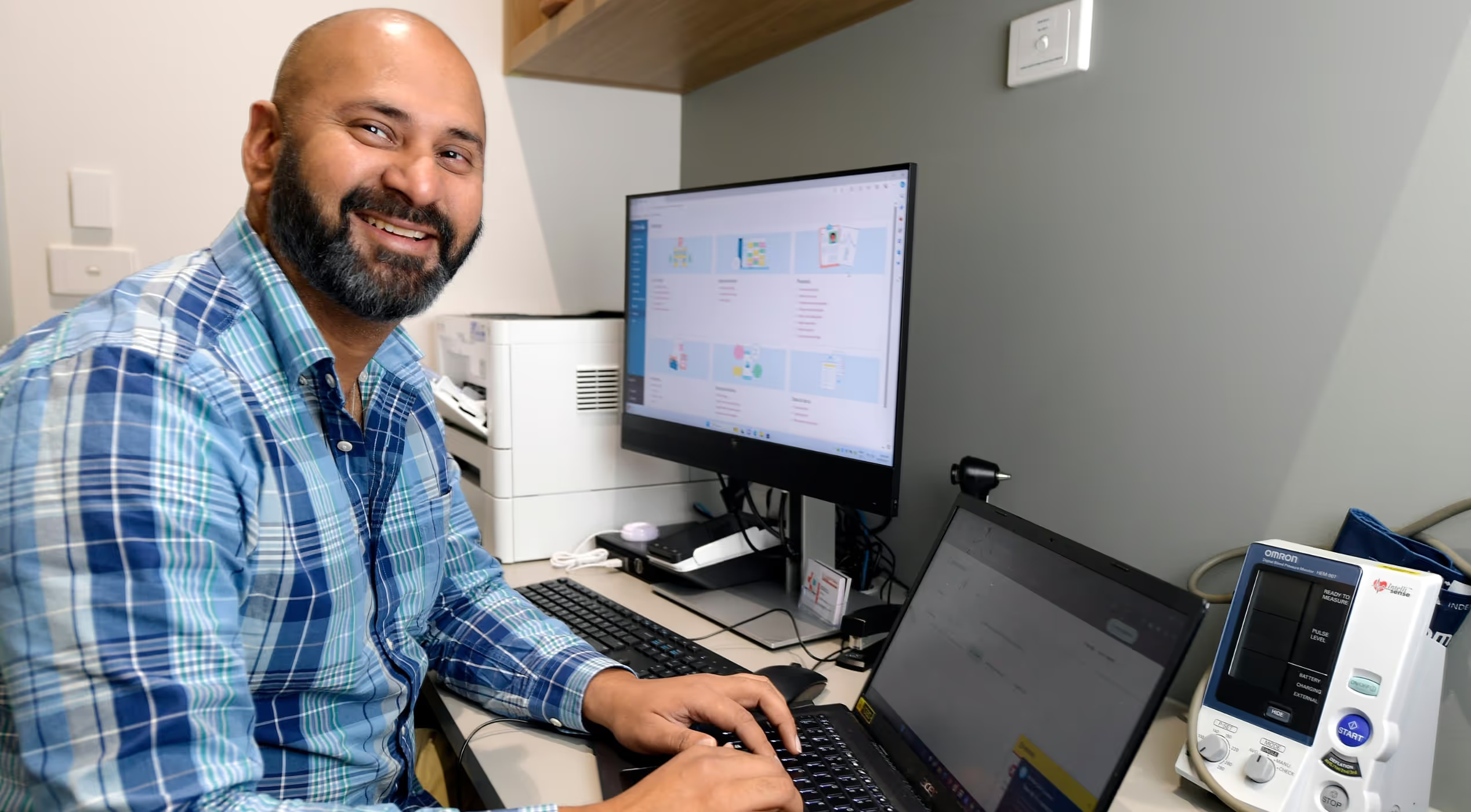
Implement digital templates with built-in prompts for diagnostic categories, evidence-based intervention approaches, and auto-text features for frequently used clinical terminology specific to speech-language pathology.
Automating Speech Pathologist Initial Clinical Notes
Automating speech pathology documentation through specialized EHR templates can reduce documentation time by 30-40% while ensuring consistent inclusion of critical assessment components and diagnostic criteria.
When transitioning to electronic documentation, incorporate standardized assessment score calculators, developmental milestone checklists, and customizable goal banks aligned with evidence-based practice in communication disorders.
3 Common Questions About Speech Pathologist Initial Clinical Notes
How detailed should my oral-motor and articulation assessment documentation be in initial notes?
Document specific observations of structural integrity, muscle tone, range of motion, strength, and coordination for all speech articulators, along with phonetic inventory, error patterns, stimulability, and phonological processes with examples from the client's speech sample.
What's the best way to document parental concerns and priorities in pediatric initial evaluations?
Include direct quotes from caregivers regarding communication concerns, document the impact of communication challenges on daily activities and social participation, note caregiver observations of strengths and challenges, and clearly articulate family priorities for intervention outcomes.
How do I properly document diagnostic impressions when findings are inconclusive?
Clearly state when a definitive diagnosis cannot be made, document the differential diagnostic possibilities with supporting evidence for each, outline additional assessments needed for clarification, and provide provisional treatment recommendations while awaiting further diagnostic information.
Final Thoughts on Speech Pathologist Initial Clinical Notes
Comprehensive initial clinical documentation forms the foundation for evidence-based practice in speech-language pathology by establishing clear baselines, diagnostic rationales, and targeted intervention plans tailored to individual communication needs.
Leveraging customizable speech pathology templates with disorder-specific assessment protocols, goal banks, and progress monitoring tools can significantly enhance clinical efficiency while maintaining high-quality documentation standards.
Speech Therapy Clinical Notes
Name: Sarah Jenkins
Referral Source: Pediatrician Dr. Emily Collins
Presenting Complaint:
Chief Complaint Details:
Sarah Jenkins, a 6-year-old female, is referred for an evaluation of speech and language concerns, specifically regarding delayed speech development. Her parents report difficulty understanding her speech due to unclear articulation, particularly with consonants. They are concerned that her communication challenges are affecting her social interactions and learning at school.
History of Presenting Condition:
Onset and Duration:
Sarah’s parents noticed speech delays around the age of 2. By the age of 3, she was not using full sentences, and her speech was predominantly characterized by single words and short phrases. Her vocabulary has gradually expanded, but articulation remains a challenge, particularly with complex words. She has received intermittent speech therapy from age 4, but the family reports that there has been no significant progress in her speech clarity.
Previous Assessments/Treatments:
Sarah has undergone a prior speech assessment at age 4, which indicated a mild delay in speech development. She was seen for speech therapy once a week for six months, but sessions were discontinued due to family scheduling conflicts. Parents report no formal follow-up assessments since then.
Impact on Daily Life:
Sarah’s speech difficulties are affecting her ability to be understood by peers, leading to frustration and social withdrawal. Her parents report that she struggles with following classroom instructions and is often unable to express herself clearly during playtime with peers. At home, Sarah’s family often has to ask her to repeat herself multiple times, which causes her emotional distress. Her language difficulties are also affecting her early literacy development, particularly in reading and writing tasks at school.
Communication Profile:
Speech (Articulation, Fluency, Voice):
• Articulation: Sarah’s speech is characterized by inconsistent misarticulations, particularly with the consonants /s/, /r/, and /k/. Substitutions such as “w” for “r” and “t” for “k” are frequently noted. There is also a pattern of sound omissions, most notably in the final consonants of words.
• Fluency: No signs of stuttering or disfluency.
• Voice: Vocal quality is within normal limits, with no signs of hoarseness or breathiness.
Language (Understanding and Use):
• Receptive Language: Sarah demonstrates age-appropriate understanding of basic instructions, such as “sit down” and “pick up your toys,” but struggles with more complex, multi-step directions.
• Expressive Language: She uses simple sentences but often omits grammatical elements such as plural forms and past-tense verbs. Sarah’s vocabulary is limited compared to her peers, and she has difficulty finding the right words during conversation, leading to pauses and filler words.
Social Communication:
Sarah’s pragmatic language skills appear to be delayed, as she has difficulty initiating and maintaining conversations with peers. During play with other children, she often becomes frustrated when they do not understand her. She is reluctant to engage in group activities, preferring to play alone. Eye contact and turn-taking are inconsistent, but she does engage in social interactions with prompts.
Literacy Skills:
Sarah’s reading is at an emergent level, with a limited ability to recognize letters and sounds. Writing skills are basic, with difficulties in letter formation and spacing. She enjoys looking at picture books but is not yet independently reading.
Cognitive-Communication Skills:
Sarah demonstrates adequate attention during sessions and can follow simple tasks with minimal cues. However, she struggles with remembering complex instructions and needs frequent redirection. Problem-solving is also a challenge; she often has difficulty finding solutions to problems in both structured and unstructured settings.
Oral Peripheral Examination:
Structural Assessment:
• Facial Symmetry: No signs of asymmetry or abnormal facial features noted.
• Oral Structures: The mouth is of normal size. Teeth alignment appears within normal limits. The hard and soft palates are intact with no signs of clefting or other structural abnormalities.
• Function: Sarah demonstrates adequate lip closure at rest, but when speaking, she struggles to maintain consistent lip closure, especially when producing bilabial sounds like “p” and “b”. Tongue movement is within normal limits for non-speech tasks but less precise during speech tasks.
Motor Function:
• Speech Muscles: Tongue and jaw strength appear appropriate for age, but there is noticeable difficulty with fine motor coordination during articulation tasks. She requires cues to accurately produce complex speech sounds.
• Swallowing Function: No issues noted with swallowing or drooling.
Hearing Screening:
Results:
Pass on both ears for pure-tone audiometry, indicating no concerns with hearing that would contribute to her speech and language delays.
Assessment Findings:
Summary:
Sarah is a 6-year-old with a speech and language delay, primarily characterized by articulation errors and difficulty with expressive language. She also demonstrates challenges with pragmatic language skills, social communication, and early literacy. These issues are impacting her ability to communicate effectively at home and school, and there is concern regarding her readiness for academic tasks, particularly in reading and writing.
Strengths: Sarah is able to follow simple commands and demonstrates age-appropriate cognitive attention for tasks when given appropriate cues. Her understanding of basic concepts is intact, and she is eager to engage in therapy.
Needs: Sarah will benefit from targeted therapy focusing on articulation, expressive language skills, social communication, and early literacy skills. There is a need for structured practice in sound production, vocabulary development, and sentence structure.
Goals for Therapy:
Short-Term Goals:
• Increase intelligibility by improving the production of the sounds /s/, /r/, and /k/ through articulation therapy, with 80% accuracy in structured practice.
• Expand expressive vocabulary by 25 new words, focusing on functional, everyday language.
• Improve use of complete sentences, including correct tense markers and plural forms, with 70% accuracy in structured activities.
• Enhance social communication skills by encouraging turn-taking and eye contact during structured play activities.
Long-Term Goals:
• Achieve age-appropriate articulation and speech intelligibility in conversation, with correct production of age-appropriate sounds across all contexts.
• Demonstrate age-appropriate expressive and receptive language skills, with improved social interactions and peer relationships.
• Demonstrate early literacy skills, including letter recognition, basic phonics, and simple sentence writing.
Plan:
Intervention Strategies:
• Articulation Therapy: Use of minimal pair practice, visual cues, and auditory discrimination exercises to target problematic sounds (/s/, /r/, /k/).
• Expressive Language Therapy: Vocabulary-building activities, including categorization and sentence construction tasks.
• Social Communication Training: Role-playing and social stories to enhance pragmatic skills and interaction strategies.
• Literacy Support: Focus on phonemic awareness, letter-sound correspondence, and simple writing exercises to support early literacy development.
Frequency and Duration:
• Therapy will be provided twice a week for 30-minute sessions. Progress will be reviewed every six weeks to assess the need for continued intervention.
Caregiver/Parent Involvement:
• Parents will be provided with weekly home practice activities to support speech sound production and vocabulary development. Strategies for encouraging turn-taking and enhancing social communication will be shared for use during play and daily interactions.
Additional Notes:
Concerns or Observations:
Sarah appeared engaged during the assessment and responded well to verbal cues. Her parents expressed a strong commitment to supporting therapy at home. One concern noted was the emotional distress Sarah exhibits when her peers do not understand her, which may be contributing to social withdrawal. Additionally, her limited early literacy skills may impact her readiness for kindergarten. Further work on emotional regulation and socialization skills may be needed in parallel with speech therapy.
Now it’s your turn.
Use this template in
PatientNotes
Speech Pathologist
Notes, Letters & Reports